"Since
time is the one immaterial object which we cannot influence--
neither
speed up nor
slow down, add to nor diminish--
it
is an imponderably valuable gift."
-Maya
Angelou
Do
you constantly feel like you are on overload? Do you tell yourself
that you'll spend more time doing something that's important but not
urgent "when things slow down a little" or "after we finish this next
big project"?
Being
technically proficient in your business or profession will only get
you so far . especially if you feel like you're on a runaway treadmill.
To gain some control and sanity, you may need to organize your time
differently.
Most business owners,
executives, and professionals spend their time in four ways:
- Free Time
- time to rest, relax, and rejuvenate
- Creative Time
- time to generate new ideas
- Delivery Time
- time to deliver the product/service that is core to your work
- Support Time
- time to handle the "behind the scenes" or administrative functions
necessary to support you in getting the results you desire.
These
four areas of time are very connected, so what you do with one dimension
of time affects the others. Have you ever noticed how taking Free
Time to rest and rejuvenate enables you to come back to your work
with a fresh perspective.one that enables you to be much more creative?
Creative
Time enables you to work ON your business. It's tough to have an
objective vantage point when you're "in the trenches" all the time.
Taking a step back to see the "big picture" is essential if you want
to generate fresh ideas and find new solutions to challenges.
Delivery
Time enables you to work IN your business. You may already spend
much of your time here. The key is to remember that it doesn't matter
how much Delivery Time you spend if what you're delivering isn't
what matters most to you or your company.and if what you deliver and
how you deliver it is not valued by the recipient of your products or
services. Direction and priorities are generally determined during Free
Time and Creative Time .
Part
of your success requires spending some Support Time tending
to details - responding to email and phone calls, reading, writing,
reviewing, evaluating, filing, etc. Of course, some of this can be delegated
to others. If you ignore the details that support your core deliverable,
it will affect your ability to be productive or deliver the best quality
product or service. In addition, you will not feel like you can take
Free Time if the unhandled details are constantly nagging at
you.
Without
Free Time , stress and overload set in. Then it's difficult
to be in a frame of mind to take Creative Time . This pushes
you to work harder IN your business ( Delivery Time ), which
results in taking a reactive rather than a proactive
approach to managing challenges. This rarely results in the best quality
results, and often adds to burnout.
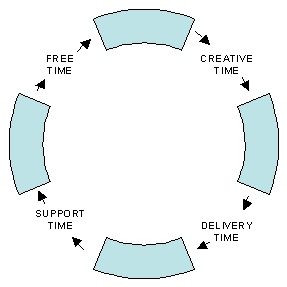
Look
at the diagram below and note that it is a continuous circle. When working
properly, the process keeps repeating itself.unless you get stuck in
one spot on the continuum.
Changing
Habits
Choosing
to live a more thoughtful, self-directed life in the midst of a society
that seems to thrive on a frenzied pace requires determination, planning,
and self-discipline. According to behavior change experts, you have
to believe in the values behind the change, or it will not stick.
For
example, if you promise your family that you will work less hours, but
you're not mentally committed to such a change, your odds of maintaining
your commitment drop. It's difficult to sustain such a promise if the
reward for working longer hours is greater than the reward for getting
home earlier.
G.
Alan Marlatt, professor of psychology and director of the Addictive
Behaviors Research Center at the University of Washington, studies people
who are successful in long-term change. Marlatt says that it gets easier
after the first 90 days. At that point, the chances of a relapse drop
from 85 percent to 20-30 percent. He also points out that adding a new
behavior is easier than trying to give something up.
Marlatt's
tips:
. Self
monitor. If you're relying on internal motivation (as opposed
to having a coach or an addiction counselor), keep a daily chart of
progress for the first 90 days. Note what needs to be fine-tuned. If
you feel you might slip, make note - either in a journal or a note card
or a bold message on your morning mirror - to get back on track.
.
Social support. Find someone or a group of people trying to
make similar changes. Meet with them or e-mail them or join a chat room.
If you're not into strangers, get a comrade, coach or family member
to be your support.
.
Keep your rewards high. New clothes for that lost weight? A
weekend away for that pared down to-do list? That keeps motivation high.
Success leads to success.
.
Watch
your self-criticism. If people go off course, the tendency is to
say, "Oh, this proves I have no willpower." That's self-defeating and
it undermines motivation.
.
Remind
yourself of goals. What is it you're trying to change? Some people
carry reminder cards that list what they want to accomplish. One man
trying to quit smoking simply carried a photo of his young son.
.
Have
a plan for when obstacles arise. How will you get back on track?
It's important not to overreact but to regroup. "I missed two days of
exercise, but I won't miss a third."
The
biggest trigger for reverting to old behaviors is a negative emotional
state, such as feeling angry or depressed, especially if you turned
to your old habit for comfort. Think of what you could do instead. Call
a friend. Take a walk. Sing a song. Do something that feels good right
away.something that will break the habit you've previously fallen into
when in a negative emotional state.
It's
easier to create a new habit than it is to stop doing an old one. So,
instead of saying, "Don't work past 6 PM," it may work better to have
a specific plan for the evening: "Be home for 6:30 dinner with my family."
Don't
be too harsh on yourself if you backslide - that's normal. As long as
you have some success, you are moving closer to your goal. Some habits
take an average of 12 attempts to quit , according to Marlatt.
But you need a plan to keep from backsliding too far. "If you have a
flat tire, it doesn't mean you're not going to finish the trip," Marlatt
says. "It just means you've got to fix it up before you continue."
Having
a mentor such as a coach can provide structure, accountability, support
and expertise to make changes stick. Coaches generally schedule a weekly
check-in time by phone to talk about goals and progress.
It's
your choice!
I hear
clients say, "I just don't have enough time!" The reality is that we
all get 168 hours a week. Challenges arise - not because you don't have
enough time - but when you have not carefully clarified and stuck with
your priorities.
A
couple years ago Krispy Kreme donuts moved into the Seattle area, where
I live. I remember reading in the paper about the Grand Opening frenzy.
The drive-through line stretched for blocks, and some people drove hundreds
of miles, only to wait several hours in line to sink their teeth into
a Krispy Kreme donut! There were even police officers hired to control
the Krispy Kreme gridlock that ensued! So how is it that we have time
to stand in line several hours for a box of donuts, but we don't have
time to do a gazillion other things that are on our to-do lists? Perhaps
it's because Krispy Kreme serves comfort food. People are emotionally
hungry, and the donuts fill a hole.
The
bottom line is this: when something is really important to you - when
you feel motivated by your inner desires - you will make the
time for it! It's difficult to sustain such things as a promise of getting
home earlier if the reward for doing so does not outweigh the motivation
for staying later at the office to work.
I've
recently returned from being away from my office for nine days. Re-entry
is challenging because of the backlog of e-mails, phone calls, mail,
etc. It's easy to fall into the trap of working longer hours to get
caught up. But if the truth be told, I'll never be caught up. There
will always be something else that I could do, no
matter how many hours I work . I've found that when I schedule time
for my top priorities, I am much more productive. Sure, some things
don't get done, but when I plan ahead, the things that do get
done are the things that really matter. By being more productive during
the day, I can get the same amount of work done and leave my office
earlier. When I neglect to do my planning, productivity goes way down,
stress goes up, and so do my work hours!

Copyright
© 2004 Kathy Paauw, All Rights Reserved. |